Cybersecurity
AI Is Making Social Engineering Almost Impossible to Detect
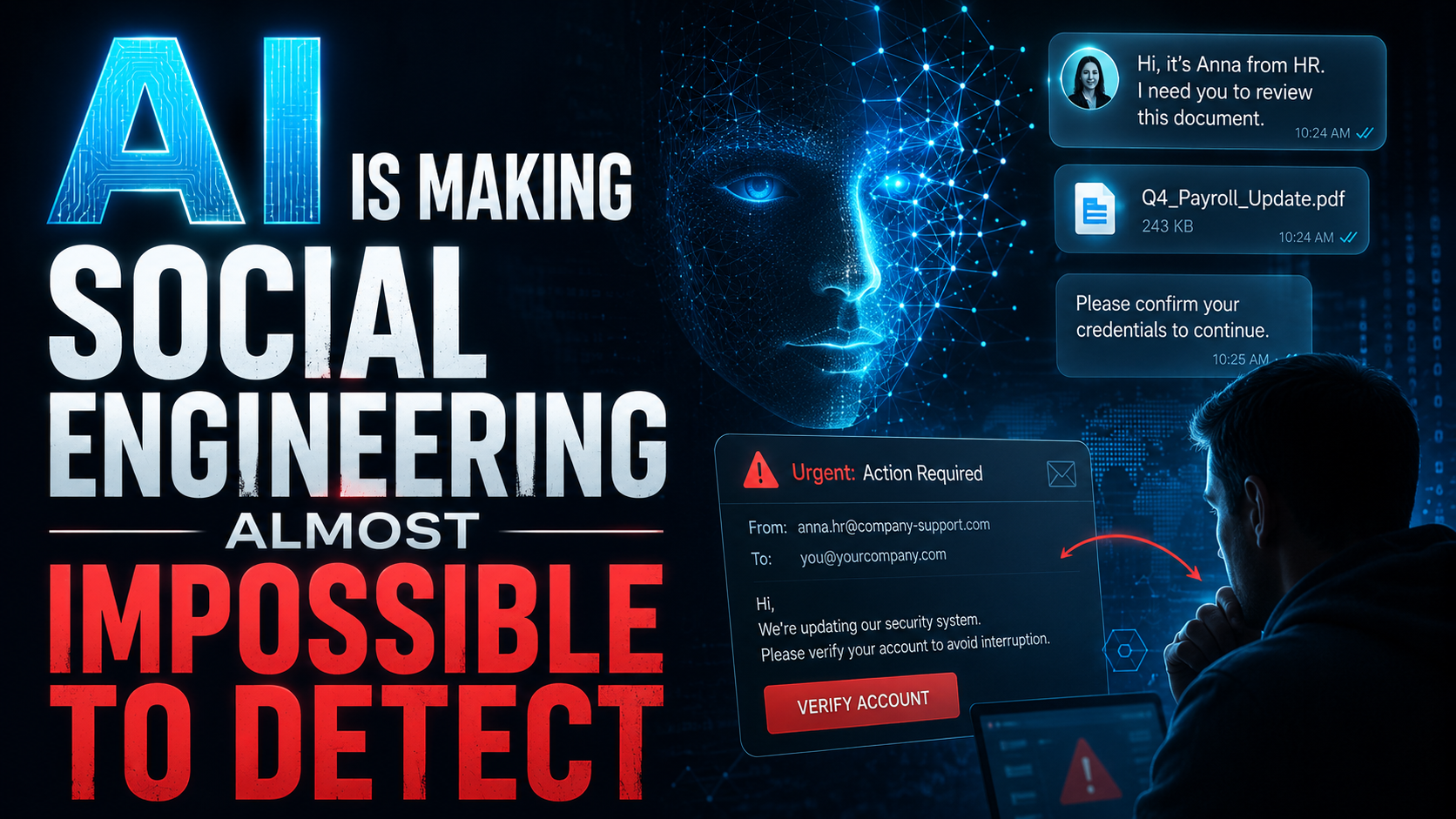
AI Is Making Social Engineering Almost Impossible to Detect
For years, the advice for spotting a phishing email was simple: look for typos, check the sender address, hover over links before clicking. If something felt off — weird grammar, an unusual tone, a request that didn't quite make sense — you'd flag it and move on.
That advice is obsolete.
Modern AI models can generate flawless, contextually appropriate text in any language, in any tone, mimicking any writing style. The grammatical errors and awkward phrasing that used to be the most reliable indicators of a phishing attempt are gone. What's left is a social engineering landscape where the old heuristics don't work, and most organizations haven't updated their playbook.
The Old Tells Are Dead
Traditional phishing relied on volume over precision. Attackers would blast thousands of poorly-written emails, knowing that a small percentage of recipients would click anyway. The emails were generic because personalization was expensive — it required research, writing skill, and time that most attackers didn't have.
AI removed all three constraints.
A large language model can scrape a target's LinkedIn, Twitter, and company bio, then generate a perfectly-written email that references a real project they're working on, mimics the tone of their actual colleagues, and includes a request that makes sense in context. It takes seconds. The output is indistinguishable from a legitimate message.
This isn't hypothetical. In 2025, CrowdStrike reported an 89% increase in AI-enabled attacks. Security firms are documenting cases where AI-generated phishing emails pass not just automated filters but human review by trained security professionals. The messages are that good.
Voice Cloning Changed Everything
Phishing emails are one vector. Voice phishing — vishing — is where AI has made the most dramatic impact.
With as little as three seconds of audio, modern voice cloning tools can generate a synthetic version of someone's voice that's nearly indistinguishable from the real thing. Not in a lab setting — on a phone call, in real time, with natural cadence, pauses, and emotional inflection.
The attack pattern is straightforward: clone a CEO's voice from a public earnings call or conference talk, call the finance department, and request an urgent wire transfer. The person on the receiving end hears their boss's voice, speaking naturally, making a request that — while unusual — isn't impossible. They comply.
This has already happened at scale. In 2024, a finance worker in Hong Kong transferred $25 million after a video call with what appeared to be the company's CFO and several other colleagues. Every person on the call was a deepfake. The worker only realized something was wrong after following up through a separate channel.
Spear Phishing at Scale
The most dangerous shift isn't any single technique — it's the economics. Spear phishing used to be reserved for high-value targets because the research and personalization required made it expensive. A nation-state actor might invest weeks crafting a convincing approach for a senior government official. A random mid-level employee wasn't worth the effort.
AI eliminated the cost barrier. An attacker can now generate thousands of highly personalized spear phishing messages — each one tailored to a specific individual, referencing their actual work, using the appropriate jargon for their industry — for essentially nothing. What used to be a targeted, resource-intensive attack is now scalable.
This means organizations can no longer rely on the assumption that most employees won't be individually targeted. Everyone is a potential entry point, and the attack they receive might be specifically crafted for them.
Why Security Training Isn't Keeping Up
Most corporate security awareness training is still built around the old model. Employees watch a video, learn to spot suspicious emails, and take a quiz. The examples shown are almost always obvious — bad grammar, suspicious attachments, urgent requests from unknown senders.
The problem is that these examples bear no resemblance to what a modern AI-driven attack looks like. When the phishing email is perfectly written, comes from a spoofed address that matches a real colleague, and references a legitimate ongoing project, the training doesn't help. Employees have been taught to look for signals that no longer exist.
Some organizations have started running more realistic phishing simulations, but even these tend to lag behind what's actually possible. The simulation might use a generic template with the employee's name inserted. An actual AI-driven attack would include details pulled from their recent Slack messages, reference a meeting they had last Tuesday, and arrive at a time consistent with their colleague's working hours.
What Actually Works Now
If the old detection methods are dead, what replaces them? A few things:
Verify Through a Separate Channel
This is the single most important habit. If you receive any request involving money, credentials, access, or sensitive data — regardless of how legitimate it looks — verify it through a completely separate communication channel. Got an email from your manager? Call them. Got a call from the CFO? Send a Slack message to confirm. Never verify through the same channel the request came in on.
Implement Technical Controls
Don't rely on humans to catch what AI generates. Deploy email authentication (DMARC, DKIM, SPF) aggressively. Use AI-powered email filtering that analyzes behavioral patterns, not just content. Require multi-party approval for financial transactions above a threshold. Enforce hardware-based MFA that can't be phished — FIDO2 keys, not SMS codes.
Assume Compromise
Design your systems around the assumption that social engineering will occasionally succeed. Segment access so that a single compromised account can't reach critical systems. Monitor for anomalous behavior after authentication, not just at the gate. Have incident response plans that account for the reality that the initial breach might look completely legitimate.
Update Your Training
If your security awareness program still focuses on spotting typos in emails, it needs an overhaul. Train employees on the verification habit, not the detection habit. The message should shift from "spot the fake" to "verify everything important, even if it looks real."
The Uncomfortable Reality
Social engineering has always been the most effective attack vector because it targets the one thing you can't patch: human judgment. AI hasn't introduced a new category of attack — it's made the existing one dramatically more effective by removing every friction point that used to slow attackers down.
The research is faster. The content is better. The personalization is deeper. The delivery is more convincing. And the cost is approaching zero.
This doesn't mean every email is a threat or every phone call is a deepfake. But it does mean that the confidence people place in their ability to distinguish real from fake is no longer warranted. The appropriate response isn't paranoia — it's process. Build verification into your workflow, lean on technical controls, and stop assuming you'll be able to tell the difference.
Final Thoughts
The security industry spent years telling people to "think before you click." That was good advice when thinking could actually help — when there were visible signs that something was wrong. In 2026, the signs are gone. The phishing email looks real. The voice on the phone sounds real. The video call looks real.
What hasn't changed is that verification works. An attacker can clone your boss's voice, but they can't intercept a separate Slack message confirming the request. They can craft a perfect email, but they can't stop you from calling the sender on a known number.
The attacks have gotten smarter. The defense doesn't need to be smarter — it just needs to be systematic.